Friday, October 13, 2006

The difference between training for fitness versus competition

One more semi-related thing and this is certainly not a commercial email.  A few of you have emailed me about fitness testing.
 
Last year about this time we organized fitness testing through our lab partner, The FitStop Human Performance Lab, also a sponsor of the Del Mar Crit Series.
 
If you're coming off your competitive season, you might consider getting tested to gauge fitness progression with the beginning and mid-season testing, as well as serving as a marker for the future (i.e. gauging your future post season test results to gauge your progress) and lay the roadmap for your winter training.
 
Whether you test with The FitStop or any other labs in the area (such as the Chek Institute), this is a good idea to do now (any time before Thanksgiving!). You'll use these numbers to plan your winter training and test again about 6-8 weeks before competition.  Then use those numbers to fine-tune your program for competition and so on.
 
If you're interested in testing, feel free to contact Ken Nicodemus at The FitStop and tell him you're a Kam/Raceplan referral to get the below pricing discounts.  Ken can be reached via email: kjnico@adelphia.net or phone:  (760) 634-5169
 
If you've tested with the FitStop before, these are the prices but don't quote me on them. Check with Ken for accuracy:
  • LT/VO2: $100
  • Metabolic testing without LT/VO2: $100  This test still calculates your levels without the need to take blood and measure LT (or OBLA to be more exact).  It's also shorter, taking just about 20min instead of 40+ with LT.
  • Dunk/Fat test: $50
  • Oxygen Economy Test: valuable for endurance athletes to measure the economy at which you fuel your body and what things you might do differently to improve this.  This of it as cleaning out your turbo. Check with Ken for pricing.
  • Cardio-Metabolic Profile: a nice to know to figure out how efficient you are at using oxygen and fuel.  Basically how your engine runs. Check with Ken for pricing.
  • Peak Power Testing: similar to a power profile that you can get from about 3 months worth of power data or a specific field test. Check with Ken for pricing.
  • Spin Economy (using Spin Scan): for the geeky of all cyclist/triathletes to see how truly screwed up your pedal stroke is! Check with Ken for pricing.
 
If this is your first time testing, you still get a discount:
  • LT/VO2 testing: Regular $220, Raceplan special is $150
  • Dunk test: $50 additional
  • Check with Ken for pricing on all other tests


========================
I came across this short article in a coaching rag and think it's relevant to a lot of us, especially this time of year as we're coming off competition, hopefully taking some time off and planning for the next season.
 
Performance Conditioning (the rag I got this article from) has long advocated that the difference between an individual participating in a sport for fitness versus that same individual participating in a sport for competition is coaching.
 
Chances are you're not as gifted genetically as a high level athlete.  Some coaches claim that genetics account for up to 90 percent of predicting athletic success.  Good genes come with natural athletic abilities that allow for advanced athletic skills and the ability to take on larger training volumes and recover from hard workouts faster.  In addition, time is a major factor.  An athlete will train up to six hours a day [while] the recreational fitness advocate puts in 30 quality minutes three to four times a week.
 
Finally, the high level athlete has a vast amount of support resources: team physicians, athletic trainers, strength and conditioning coaches, sport psychologist and nutritionists all are available to the high level athlete on a continuous basis.
 
But there are some important similarities that you enjoy with the high level athlete.  The first is your love of sport you do as a fitness activity.  This is an important motivational factor.  The next is the principles of how the body works and develops are the same and the mechanism for injury and its limitations to performance have the same outcome.  You both have goals you wish to achieve based on your abilities.  This makes planning very similar.  You may think that an athlete faces little or no distractions and adversities. This is not true.  They are just different.  Life's challenges are the same, the difference is how they are handled.
 
Something to think about.
 
Kam Zardouzian
Kam Zardouzian
Chief Instigator
Raceplan Coaching & Racing
Kam@Raceplan.com
http://www.raceplan.com
mobile: 858-414-2624
Add me to your address book... Want a signature like this?


====================================
 
====================================
Del Mar Criterium Series
====================================
Team Beat Cancer
====================================
 

--
No virus found in this outgoing message.
Checked by AVG Free Edition.
Version: 7.1.408 / Virus Database: 268.13.3/474 - Release Date: 10/13/2006

The difference between training for fitness versus competition

I came across this short article in a coaching rag and think it's relevant to a lot of us, especially this time of year as we're coming off competition, hopefully taking some time off and planning for the next season.
 
Performance Conditioning (the rag I got this article from) has long advocated that the difference between an individual participating in a sport for fitness versus that same individual participating in a sport for competition is coaching.
 
Chances are you're not as gifted genetically as a high level athlete.  Some coaches claim that genetics account for up to 90 percent of predicting athletic success.  Good genes come with natural athletic abilities that allow for advanced athletic skills and the ability to take on larger training volumes and recover from hard workouts faster.  In addition, time is a major factor.  An athlete will train up to six hours a day [while] the recreational fitness advocate puts in 30 quality minutes three to four times a week.
 
Finally, the high level athlete has a vast amount of support resources: team physicians, athletic trainers, strength and conditioning coaches, sport psychologist and nutritionists all are available to the high level athlete on a continuous basis.
 
But there are some important similarities that you enjoy with the high level athlete.  The first is your love of sport you do as a fitness activity.  This is an important motivational factor.  The next is the principles of how the body works and develops are the same and the mechanism for injury and its limitations to performance have the same outcome.  You both have goals you wish to achieve based on your abilities.  This makes planning very similar.  You may think that an athlete faces little or no distractions and adversities. This is not true.  They are just different.  Life's challenges are the same, the difference is how they are handled.
 
Something to think about.
 
Kam Zardouzian
Kam Zardouzian
Chief Instigator
Raceplan Coaching & Racing
Kam@Raceplan.com
http://www.raceplan.com
mobile: 858-414-2624
Add me to your address book... Want a signature like this?


====================================
 
====================================
Del Mar Criterium Series
====================================
Team Beat Cancer
====================================
 

Monday, September 18, 2006

No argument against helmets: Gary's freak accident on Friday and Steve's on Sunday

Most of you received Gary's email on Friday:  A freak piece of wood lodged itself between his fork and wheel and launched Gary into orbit.  Gary hit his head, cracked his helmet, bent his frame, got a bit of road rash and shock.  It could have been a lot worse.  Sitting two back from him, I was witness to this bizarre accident.
 
An article was sent out last week about a British scientist who did a study and said cyclist who wear helmets are more prone to accidents with cars, and therefore serious injury and death, than cyclist who don't wear helmets.
 
Rubbish. 
 
We wear helmets to protect against accidents such as the one Gary had on Friday.  Not to make us feel invincible.   Helmets add a layer of protection and are not invincible shields against major impact.  Just an added layer of insurance.  Ask Gary...had it not been for his helmet, his head would have been cracked.
 
As further evidence, this time I was personally involved in another accident on Sunday when Steve Cahill and I locked arms when we both tried to occupy the same space and time.  Steve went down hard, hit his shoulder, got road rash and (you guessed it) broke his helmet.  I was fortunate to have kept upright although somehow broke a couple of spokes and limped home.  But, once again this is proof that accidents happen and helmets provide a layer of protection that is well worth the expense and any inconvenience.
 
Wear your helmet...at minimum during serious training and definitely during group rides.
 
The following link is to pictures of Gary's accident.

Aug 12, 2005 by Kam


helmets, helmets, helmets
If you are having problems viewing this email, copy and paste the following into your browser:
http://picasaweb.google.com/kzardouzian/CyclingStuff

--
No virus found in this incoming message.
Checked by AVG Free Edition.
Version: 7.1.405 / Virus Database: 268.12.5/450 - Release Date: 9/18/2006

Tuesday, September 12, 2006

Erika Barajas & Team Beat Cancer


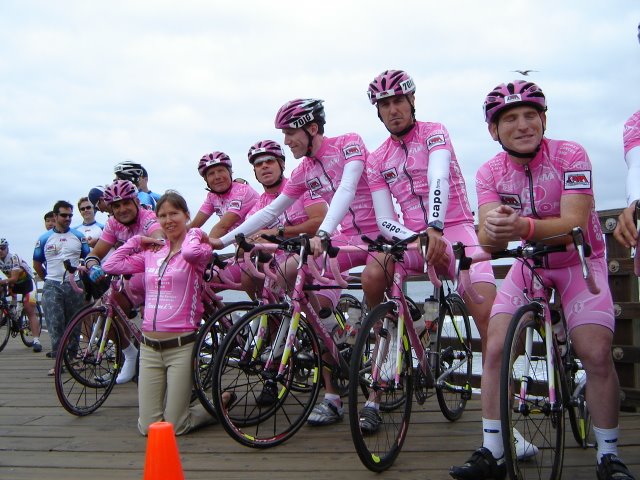
I was shuffling through some pictures and came across this photo of Erika with the 2006 24-hr Beat Cancer Team at the start of the RAAM on Oceanside Pier.

Erika lost her 2.5 year battle with cancer last Wednesday, September 7th.

I have not had the opportunity to speak with the team, but I've been very sad since I heard news of her passing.This picture reminds me of everything we did in her support, but wish we could have done more to help directly. But what?

What I do know is that her fight touched many lives and brought a lot of us closer together. I will personally remember her embracing energy and smile. I miss her and will keep her family in my prayers.
 Posted by Picasa

Wednesday, August 23, 2006

Off season already?

I began my off season about three weeks ago and started running and swimming.  OUCH!  I had forgotten how much these "other" sports hurt when you haven't done them in a while.  But, after two weeks, the pains started going away and I actually started feeling good.  Last Sunday's hour + 45min run marked the first time I ran for more than a hour in 7 years!  And despite some tenderness in my knees and ankles, I'm feeling pretty good.
 
For some of you it's still too early to begin talking about the off season.  For other, like yours truly who's been racing since October 2005, it's definitely time to start thinking about off season activities.  Ahhhhh, the joy of trying out new things, like chocolate cake!
 
Truth is, August is kind of a funny month.  Most athletes, pro and non-pro, go through a bit of a lull during this month.  The big question in every athlete's mind: am I feeling tired because training and racing is catching up with me OR do I need to train more/harder?
 
The answer, like most questions of this caliber, is a bit tricky.  While I like to avoid giving a general answer to every athlete, if you've been following a rather "normal" training program for the past 6-8 months, then it's time for you to take a bit of mid-season breather.  Taking 4-7 days completely off the bike and tending to things you've neglected such as working on the house, catching up with friends and family, paying your taxes from last year, etc. is good for you and everyone around you.
 
Taking a few days off the bike will help you physically and mentally.  Don't worry, you've built plenty of fitness to where you won't lose momentum.  But, care must be taken to plan for your time off AND your return to training.  Choose the wrong time or come back to fast too early and you can risk injury and/or a drop in your fitness.  This is especially true if your racing season is not yet over.
  • A typical calendar for one of my athletes includes a rather sizeable build-up in training and racing intensity leading up to the first week in August, which includes new high levels of intensity (as in going hard) and duration (as in actual minutes on the bike during training and racing).
  • Immediately after the final day of the intensity (race day or hard training), we do an easy 30-60 spin keeping it in the small chain ring, staying light on the pedals and keeping heart rate below 115-120.  This easy ride will help flush out a lot of residue build-up in your body and aids recovery.
  • Then it's 4-7 days completely off the bike.  As a matter of fact, this is a great time to take your bike in to the shop for some mid-season overhaul action.  The point is to not even look at your bike and avoid all temptation to ride.  You can still do other physical activities BUT, and this is important, keep it light, keep it fun and use moderation.  What ever you do (running, roller blading, surfing, hiking, Yoga, hacky sack, yard work, etc.) expect to be sore.  Soreness is not caused by lack of fitness, rather it's caused by specificity of fitness caused by hours of cycling.  In other words, you are fit for the stress of cycling but you are not fit for other sports or activities.  As coaches, this is what we're looking for.
  • Coming back to training must be planned out carefully.  I usually start the first week with the 2 on, one off, three on, one off program: two days of training followed by a rest day, three days of training followed by a rest day.  Intensity is usually kept at or below endurance level and duration is no longer than 180 minutes for the longest training session.  The athlete can expect to feel lethargic and sore during this week, which is perfectly normal.
  • The second week, depending on how well the athlete followed her program (i.e. didn't go hammering with anyone and stayed true to her program), builds by 10-15% in volume and perhaps intensity.  This depends on the athlete's late season racing goals.  If there are races coming up, we focus on proactively building intensity.  If there are no major races coming up, then we can take our time with building intensity.  By the middle to end of the second week, the athlete is feeling super charged, rested and feeling really good on the bike.
As summary, it's perfectly normal to be feeling a bit of lethargy this time of year and taking some time off is perfectly normal. Plan on taking a few days completely off the bike after a big race and/or training week.  Allow yourself one day of recovery spin to help flush out your body then being taking time off.  Stay active but don't over do it.  Come back slowly and methodically. Seek the advice of your coach!
 
Be Fast,
 
Kam
 
Kam Zardouzian
Kam Zardouzian
Chief Instigator
Raceplan Coaching & Racing
Kam@Raceplan.com
http://www.raceplan.com
mobile: 858-414-2624
Add me to your address book... Want a signature like this?


====================================
National Director of Collegiate Cycling
USA Cycling
====================================
Founder
Del Mar Criterium Series
====================================
Manager, Team Beat Cancer
====================================


Friday, August 04, 2006

Those darn saddle sores

A client recently commented on how her saddle sores have impacted her her training and racing and I thought this will make a good topic for the group.
 
Truth is, if you ride a bike long enough, you'll get them.  I remember the first time I battled them.  It was during training for the the 1993 Canadian Ironman.  I followed the advice of a friend I was training with and smeared Noxema in my shorts during training.  Come to find out that Noxema, or any other oil based cream for that matter, either works well or doesn't at all.  In my case, it did not work at all.  The oils in the cream clogged up my sweat pours and, to keep it as short as possible for obvious reasons, I showed up to the race with at least 11 saddles sores, the largest the size of a nickel.  I remember how painful it was for me to sit in the airplane and wondering how I was going to ride 112 miles with my butt in the condition it was in. 
 
My saddle sores were so bad that I had to visit the emergency the day before the race and get some medical advice as to how to best manage the pain and potential physiological issues that may result from racing on them.  The nice doctor's words were "well, I'm not going to tell you not to race because obviously you've sacrificed a lot and are here.  The only thing I can do is to help make you as comfortable as possible."  With that, he gave me a copious amount of topical numbing cream and two syringes of Novocain.  The instructions: if the pain gets too bad during the ride, pull over, apply the numbing cream and shoot yourself in the ass with Novocain.
 
I came really, really close to pulling over, but chose not to.  Needless to say, my bike time was an hour slower than anticipated, but I gladly gave up the bike and had a stellar run as a result of being forced to be conservative on the bike.
 
With that, I vowed to learn as much as I can about saddle sore and am sharing for others to benefit from.  Saddle sores are usually associated with:
  • Chafing: The constant rubbing against the saddle caused from the normal cycling motion can cause chafing of the groin and inner thighs. This is why you want to buy as thin a saddle as will support you (by the Ischia tuberosities - your "sit bones") and why cyclists usually wear good quality, skin tight cycling shorts. 
  • Boils and "in-grown hairs": Both of these are from bacterial infections. "In-grown hairs," or folliculitis, is not such a problem, occurs frequently where you have a lot of rubbing and a lot of hair in tight clothing, and tend to heal on their own without causing pain. On the other hand, boils, or furuncle, which look a lot like acne are from bacterial infections, and can become large, hard, and really, really hurt! You really don't want to get a boil in the wrong place, or your bike won't seem so friendly to you anymore! If this is a frequent problem, ask your physician about preventative treatment with anti-bacterial ointments. The important lesson here is to always wear clean shorts, and to get out of your cycling clothes as soon as you can after a ride.
  • Sore Backside: This is when the flesh that you're sitting on becomes red, inflamed, and sore. Here it's important to check the fit of the bike, and to check that the saddle is both level and wide enough to hold you up by the pointy extrusions on your rear-end that actually make contact with the padded, back part of the saddle. Women should definitely get a saddle that is built for their wider pelvises. 
  • Skin Ulceration: Basically, this is rubbing the skin off, causing a crater-like lesion. Ouch! If you ride a long tour - 100+ miles/day for five days or more, you are a candidate to develop an ulceration. This definitely should not be ignored, and you should seek medical treatment. If you ride on it untreated, you are at serious risk of getting a much worse skin infection.
Lessons learned:
1. most obvious: hygiene.  spending unnecessary shammy time, especially after working out/racing.  Get out of those things fast.  If you can't shower, carry Purell-type antibacterial gel with you and rub some down south to kill any residue.  some women have problems with that stuff because of the alcohol, which may cause a bladder infection.  Other options include baby wipes, the unscented ones.  others have had good success with liquid acidophilus...yes, the same kind you drink.  You can use it topically as well.  The point is that you've got to keep that area clean and dry. 
 
2. clothing: some shammys are better than others.  I understand you may not have much choice with your team kit, but during the off season, you've got to train in the best shorts available, keep them clean and use plenty of shammy cream (I've found the Assos for winter time because of the menthol action and/or Shammy Butter for summer time to be best)
 
3. your fit: being positioned properly on the bike is also important.  Be stretched out too far or not far enough will put pressure on your sensitive parts and cause rubbing, which will in turn cause the above problems.
 
4. quality of saddle: saddles break down after a while and pressure points will develop.  kind of like an old couch.  I make a habit of changing my saddle at least every 18 months. 
 
5. keeping it clean, let the healing begin:  I normally scrub the area in the shower pretty well with a good quality soap and clean wash towel.  When needed, after drying I apply a bit of antibacterial gel and let air dry.  I then apply either Neosporin with pain killer or Desitin (for baby rash) to micro-areas that need it most.  Then I wear loose clothing and let mother nature do its thing.
 
Well that's about it.  Your comments/input is welcome as always.  Keep the pictures to yourself!
 
 
Kam Zardouzian
Kam Zardouzian
Chief Instigator
Raceplan Coaching & Racing
Kam@Raceplan.com
http://www.raceplan.com
mobile: 858-414-2624
Add me to your address book... Want a signature like this?


=================
National Director of Collegiate Cycling
USA Cycling
719.201.1004
=================
Founder
Del Mar Criterium Series
=================
Come Race with us at the RAAM
 

Monday, June 19, 2006

Team Beat Cancer -- Winners 2006 24-hr RAAM

Top Row (L-R): the team commando hugs the support crew for a job well done, the "Pink Team" in formation during the 13-mile parade ride, the team assembled with about 5 miles to the finish in Flagstaff, AZ and rode in together.

Middle row (L-R): Kam putting the hammer down in the desert, the team with Erika in front before the start at Oceanside Pier, our trusty pink Serotta Ti Legends in formation at the finish.

Bottom row (L-R): the entire team at the finish, Gary and Tyler hammered the downhill into Borrego Springs averaging well over 50 MPH, the entire team the day before the start. Posted by Picasa