Friday, December 15, 2006

Crit pointers from Cal Cycling....


Cal Cycling - Geo's Criterium Tips

Equipment:

The equipment selection isn't as complicated as TTing. All you really need is a set of light race wheels. You can use a set of swanky-er aero wheels if you wish. Try to find a rear wheel that has a tight cluster, you want to be in the most efficient gear to conserve your energy. Most importantly try to find a cluster with a 16 in it (for those with 9spd, that is a 12x23). THe 53x16 turns out to be the perfect cruising gear for crits--the 17 and 15 are close for small speed adjustments. I used to ride a 9spd 11x23, the 11t cog was useful, but once I tried one with a 16, the world turned into a much nicer place. With the 11x23, the 17 was too easy, but the 15 was too hard... Since crits are over in an hour, you might get a chance to drink so pack a small bottle of sugary stuff when you roll out.
Preparation:

Training for a crit requires all round skills you accumulate as you ride. All round fitness (plus explosive power generation) and bike handling skills are necessary to survive a crit. Crits can get nutty, you need to have a good solid aerobic base so you can keep up and a good jump so you can bridge the little gaps that inevitably open up during a race. Also, hopefully those that attended those skills clinics in the fall can appreciate the close quaters riding we practiced and have by now learned what they can and can't do on their bikes. Remember to stay cool when you get into a jam. As soon as you hit the panic button everything really starts to fall apart.
Race day:

You should reg as soon as you can, thereby allowing yourself the maximum amount of time to get pinned and warmed up. Crits are fast from the gun, so you want to be nice and warm at the line. If you need to eat anything, don't eat too much...again, something light and quickly absorbed. The warmup on the trainer I'll leave up to your own personal preferences. Just make sure you have a variety of efforts (almost up to race pace) so that your body "knows" what's in store for it. Make sure your team has a set of wheels in the pit, in case there are any, uh, technical difficulties encountered in the race.

The start is fairly critical, try to line up as close to the line as you can...it's just less people to snake through later. Put your bike into the big ring and some gear you can start on (usually a 19).

Before the race starts, the official comes out and gives a little talk as to free laps, reads you your final rites, etc, etc. Do as they say. As soon as they scurry off the road, get ready to go. When the whistle blows, KEEP your head UP, don't look down to engage your cleat into the pedals. Infallibly there is going to be some guy that has to look down to do it, and they are just going to veer off into somebody else when they do it. Keep your eyes peeled and at try to get off the line safely. Once the race has started, you'll initially settle into a position. From there you have to decide your own game plan. Every crit is different, race dynamics are never the same, so it's hard to write down a specific game plan--so here are some general pointers...

The first crit I did up in Davis, I got dropped like a ROCK. It was pa-thet-ic. I had absolutely no skills whatsoever.

A crit can get crazy, people all over the place, speeding up, slowing down. Key concept to follow is to try and conserve energy. Try to stay up front, the pace up there is much more stable so you don't have to waste energy bridging little gaps. (Hopefully you have your crazy light wheels on so you can accelerate faster...) You hit the corners first so you can have the pick of what line you want (somewhat). Plus you have less yahoos in front of you to foul things up. Don't aim for bots-dots, pot-holes, oil spots, man hole covers and other irregularities in the pavement... (Hopefully you have your stickest set of rubber on so you can rail it through anything). If you can sit in on a wheel, sit in on it. Well, if the wheel happens to be erratic, steer clear you don't wnat another thing to watch out for. If there is a gap you can take advantage of, take it. Try to keep on moving up. In corners, stay relaxed there might be a little bit of bumping, but nothing the skills clinic didn't teach. Protect your front wheel as much as possible--you lose that, you're a goner. Stay smooth, don't let your nerves get to you and get all sketchy. It makes racing with you that much harder. During corners, keep pedaling as much as you can into it, take and hold a smooth line. Resume pedaling as soon as you can when you exit the corner.

During bell laps things get even crazier. Again, keep your cool and try to maintain position. If you are top 5 on bell lap for a prime, you are in a good position to earn points. Capitalize on it.

By the final bell lap, things will be off the hook. This will be the craziest racing you will see. By now, you want to be at least top 10 going into it. Ideally top 5 by the last corner, and put the smack down in the last straightaway.

Sounds a lot easier than it really is, but its a lot of fun. Keep at it. Once you the hang of it, there is another world of team tactics to learn. It really is a lot of fun.

When the race is finally over, be sure to cool down and drink some sugary stuff/Cyto-sludge to help you recover.

It's hard to put down *everything* that goes on in a crit onto (virtual) paper. Hopefully all you newbies have read something that will help your racing endeavors. Remember: Good judgement comes from experience. Experience comes from bad judgement. If you have a chance to do those Early Bird races, give them a shot, nothing beats actual hands on race experience.


powered by performancing firefox

Friday, November 24, 2006

Friday's EuroFile: Hamilton signs a contract; Race organizers consider anti-trust challenge

Friday's EuroFile: Hamilton signs a contract; Race organizers consider anti-trust challenge: "This report filed November 24, 2006

Tyler Hamilton has signed a one-year deal with the Italian/Russian Tinkoff cycling team it was announced in Rome on Friday.

Hamilton is back, with a one-year deal with the continental Tinkoff squad.

photo: Agence France Presse (file photo)
The year-old continental team is bankrolled by Russian brewery magnate Oleg Tinkov and has recently been working to sign German Tour de France winner Jan Ullrich.

Hamilton, once one of the sport's top stars, completed a two-year ban for blood doping in September. Hamilton had hoped to sign with a ProTour team and return to the top level of the sport, but settled for a contract with the Continental squad as that option appeared unrealistic. In recent months UCI officials made it clear that they would strictly interpret the ProTour code of ethics, which requires that riders be banned from the top level of the sport for a period twice as long as their original doping suspensions."

Tuesday, November 21, 2006

To lift or not to lift....

A rather unusually large number of you have inquired about strength training in concert with on-the-bike training this time of year.  Could be that Thanksgiving is here, could be the change in daylight, or could be the new phase of the moon.  Not sure.  But I thought perhaps some of you can benefit from the following:
 
Q: will strength training work for me?
A: umm, yeah!  if you do it right.  just like anything else you'll get what you put into it.  meaning if you just go to the gym and lift you will gain some initial strength but that will plateau after a while.  If you follow a periodized plan that builds strength and peaks it based on your training/racing goals, you will get much better results.  Remember, you are investing the time and energy so make sure you're also getting the most benefit in return.
 
Q: how many days per week should I lift?
A: It totally depends on number of factors such as your experience (athletic age) and current fitness level, if you have been following a strength program, your goals, if you have any injuries, other training you  are doing, etc.   The one thing you don't want to do is go from scratch to lifting hard.  Consider this: it takes between 4-6 weeks for damaged muscles to repair themselves.  If you lift hard without having the proper foundation you will tear your muscles.  Training on top of that will only further the damage and this is how people end up getting injured or with Chronic Fatigue Syndrome or audited by the IRS.
 
Q: I prefer Yoga instead of going to the gym and being a muscle head.  Will that work?
A: Initially yes.  you will gain some general strength and flexibility, which helps especially if you are a masters athlete.  Depending on your goals, at some point you want to incorporate specificity into your strength program.  Kind of like if you ride 300 miles per week at 20MPH, you'll have a hard time racing a TT at 28MPH.
 
==>I'll tell you what, during the transition and foundation phases (see below) one of the best things you can do is to attend a boot camp two or three times per week.  Be sure to work out the details with your instructor so s/he works with you to ramp up.  Boot camps are in baby...you get a great strength workout on top of a great cardiovascular workout.  Patrick Jak, the infamous Raceplan coach, who is also a strength train pain master, is starting a boot camp in the Del Mar/Carmel Valley area.  If you are interested, please email him at Pat@raceplan.com
 
Q: What are the most important areas to strength train for cycling?
A: you can not ever go wrong with strengthening your core...ever!  The area from the bottom of your rib cage to about the middle of your hamstrings do the majority of work.  So hit these but don't neglect the other areas.  For cycling, general all around strength is key, but you won't need 32 inch biceps!  Generally speaking, start from your lower back and stomach and work down to your calves.
 
Last, this is very *general* strength training calendar I have used with my athletes over the past 6 years.  I modify this calendar based to accommodate for athletic maturity, goals, geographic location, racing season, etc., which also determine the specificity of exercises and number of reps/sets.  We also perform a strength test after the initial transition phase to determine the athlete's level of fitness and intensity level for his/her training...this is similar to an LT/VO2 test and will help determine the actual amount of weight the athlete should throw around in the gym. 
 
RACEPLAN STRENGTH TRAINING SCHEDULE
MONTH PHASE GOAL WEEKS ACTIVITY DAYS/WEEK INTENSITY
November-December Transition Prepare the muscular-skeletal system for more strenuous strength training  3-4 3 sets of 15-20 reps  2-3 <50%
December-January Foundation Increase weight and intensity, start building more foundation to prepare the body for more intensity by building gradually  4-6  3-4 sets, 8-12 reps 3 50%-70%
January-February Basic Start the first intensity phase by lowering the reps and increasing the number of sets and weight.  4-6  5-7 sets, 2-6 reps 3 80%-100%
February-March Power This is where we transition from the strength you've built to date by focusing it towards the specific task of cycling.  Form and technique play an important role as we slow the negative stroke and explode on the positive.  You'll also do one-legged exercises, while transitioning between spinning.  4-6 5-6 sets of 11-15 reps  2-3 <70%
April => Peaking Further focusing of strength built in the gym to the specific task of cycling.  If you're a masters cyclist, you'll continue strength work through the season with 1-2 days a week.  All other cyclists, including junior cyclists, transition from gym work to on-the-bike strength work. 4+ 1-3 sets of 6-10 reps 2-Jan <60%
 
 
If you have any questions or comments, you can either submit them to the Raceplan Group (Raceplan@yahoogroups.com) and/or visit the Raceplan Blog (http://raceplan.blogspot.com/)


Kam Zardouzian
Kam Zardouzian
Chief Instigator
Raceplan Coaching & Racing
Kam@Raceplan.com
http://www.raceplan.com
mobile: 858-414-2624
Add me to your address book... Want a signature like this?
 

Friday, October 13, 2006

The difference between training for fitness versus competition

One more semi-related thing and this is certainly not a commercial email.  A few of you have emailed me about fitness testing.
 
Last year about this time we organized fitness testing through our lab partner, The FitStop Human Performance Lab, also a sponsor of the Del Mar Crit Series.
 
If you're coming off your competitive season, you might consider getting tested to gauge fitness progression with the beginning and mid-season testing, as well as serving as a marker for the future (i.e. gauging your future post season test results to gauge your progress) and lay the roadmap for your winter training.
 
Whether you test with The FitStop or any other labs in the area (such as the Chek Institute), this is a good idea to do now (any time before Thanksgiving!). You'll use these numbers to plan your winter training and test again about 6-8 weeks before competition.  Then use those numbers to fine-tune your program for competition and so on.
 
If you're interested in testing, feel free to contact Ken Nicodemus at The FitStop and tell him you're a Kam/Raceplan referral to get the below pricing discounts.  Ken can be reached via email: kjnico@adelphia.net or phone:  (760) 634-5169
 
If you've tested with the FitStop before, these are the prices but don't quote me on them. Check with Ken for accuracy:
  • LT/VO2: $100
  • Metabolic testing without LT/VO2: $100  This test still calculates your levels without the need to take blood and measure LT (or OBLA to be more exact).  It's also shorter, taking just about 20min instead of 40+ with LT.
  • Dunk/Fat test: $50
  • Oxygen Economy Test: valuable for endurance athletes to measure the economy at which you fuel your body and what things you might do differently to improve this.  This of it as cleaning out your turbo. Check with Ken for pricing.
  • Cardio-Metabolic Profile: a nice to know to figure out how efficient you are at using oxygen and fuel.  Basically how your engine runs. Check with Ken for pricing.
  • Peak Power Testing: similar to a power profile that you can get from about 3 months worth of power data or a specific field test. Check with Ken for pricing.
  • Spin Economy (using Spin Scan): for the geeky of all cyclist/triathletes to see how truly screwed up your pedal stroke is! Check with Ken for pricing.
 
If this is your first time testing, you still get a discount:
  • LT/VO2 testing: Regular $220, Raceplan special is $150
  • Dunk test: $50 additional
  • Check with Ken for pricing on all other tests


========================
I came across this short article in a coaching rag and think it's relevant to a lot of us, especially this time of year as we're coming off competition, hopefully taking some time off and planning for the next season.
 
Performance Conditioning (the rag I got this article from) has long advocated that the difference between an individual participating in a sport for fitness versus that same individual participating in a sport for competition is coaching.
 
Chances are you're not as gifted genetically as a high level athlete.  Some coaches claim that genetics account for up to 90 percent of predicting athletic success.  Good genes come with natural athletic abilities that allow for advanced athletic skills and the ability to take on larger training volumes and recover from hard workouts faster.  In addition, time is a major factor.  An athlete will train up to six hours a day [while] the recreational fitness advocate puts in 30 quality minutes three to four times a week.
 
Finally, the high level athlete has a vast amount of support resources: team physicians, athletic trainers, strength and conditioning coaches, sport psychologist and nutritionists all are available to the high level athlete on a continuous basis.
 
But there are some important similarities that you enjoy with the high level athlete.  The first is your love of sport you do as a fitness activity.  This is an important motivational factor.  The next is the principles of how the body works and develops are the same and the mechanism for injury and its limitations to performance have the same outcome.  You both have goals you wish to achieve based on your abilities.  This makes planning very similar.  You may think that an athlete faces little or no distractions and adversities. This is not true.  They are just different.  Life's challenges are the same, the difference is how they are handled.
 
Something to think about.
 
Kam Zardouzian
Kam Zardouzian
Chief Instigator
Raceplan Coaching & Racing
Kam@Raceplan.com
http://www.raceplan.com
mobile: 858-414-2624
Add me to your address book... Want a signature like this?


====================================
 
====================================
Del Mar Criterium Series
====================================
Team Beat Cancer
====================================
 

--
No virus found in this outgoing message.
Checked by AVG Free Edition.
Version: 7.1.408 / Virus Database: 268.13.3/474 - Release Date: 10/13/2006

The difference between training for fitness versus competition

I came across this short article in a coaching rag and think it's relevant to a lot of us, especially this time of year as we're coming off competition, hopefully taking some time off and planning for the next season.
 
Performance Conditioning (the rag I got this article from) has long advocated that the difference between an individual participating in a sport for fitness versus that same individual participating in a sport for competition is coaching.
 
Chances are you're not as gifted genetically as a high level athlete.  Some coaches claim that genetics account for up to 90 percent of predicting athletic success.  Good genes come with natural athletic abilities that allow for advanced athletic skills and the ability to take on larger training volumes and recover from hard workouts faster.  In addition, time is a major factor.  An athlete will train up to six hours a day [while] the recreational fitness advocate puts in 30 quality minutes three to four times a week.
 
Finally, the high level athlete has a vast amount of support resources: team physicians, athletic trainers, strength and conditioning coaches, sport psychologist and nutritionists all are available to the high level athlete on a continuous basis.
 
But there are some important similarities that you enjoy with the high level athlete.  The first is your love of sport you do as a fitness activity.  This is an important motivational factor.  The next is the principles of how the body works and develops are the same and the mechanism for injury and its limitations to performance have the same outcome.  You both have goals you wish to achieve based on your abilities.  This makes planning very similar.  You may think that an athlete faces little or no distractions and adversities. This is not true.  They are just different.  Life's challenges are the same, the difference is how they are handled.
 
Something to think about.
 
Kam Zardouzian
Kam Zardouzian
Chief Instigator
Raceplan Coaching & Racing
Kam@Raceplan.com
http://www.raceplan.com
mobile: 858-414-2624
Add me to your address book... Want a signature like this?


====================================
 
====================================
Del Mar Criterium Series
====================================
Team Beat Cancer
====================================
 

Monday, September 18, 2006

No argument against helmets: Gary's freak accident on Friday and Steve's on Sunday

Most of you received Gary's email on Friday:  A freak piece of wood lodged itself between his fork and wheel and launched Gary into orbit.  Gary hit his head, cracked his helmet, bent his frame, got a bit of road rash and shock.  It could have been a lot worse.  Sitting two back from him, I was witness to this bizarre accident.
 
An article was sent out last week about a British scientist who did a study and said cyclist who wear helmets are more prone to accidents with cars, and therefore serious injury and death, than cyclist who don't wear helmets.
 
Rubbish. 
 
We wear helmets to protect against accidents such as the one Gary had on Friday.  Not to make us feel invincible.   Helmets add a layer of protection and are not invincible shields against major impact.  Just an added layer of insurance.  Ask Gary...had it not been for his helmet, his head would have been cracked.
 
As further evidence, this time I was personally involved in another accident on Sunday when Steve Cahill and I locked arms when we both tried to occupy the same space and time.  Steve went down hard, hit his shoulder, got road rash and (you guessed it) broke his helmet.  I was fortunate to have kept upright although somehow broke a couple of spokes and limped home.  But, once again this is proof that accidents happen and helmets provide a layer of protection that is well worth the expense and any inconvenience.
 
Wear your helmet...at minimum during serious training and definitely during group rides.
 
The following link is to pictures of Gary's accident.

Aug 12, 2005 by Kam


helmets, helmets, helmets
If you are having problems viewing this email, copy and paste the following into your browser:
http://picasaweb.google.com/kzardouzian/CyclingStuff

--
No virus found in this incoming message.
Checked by AVG Free Edition.
Version: 7.1.405 / Virus Database: 268.12.5/450 - Release Date: 9/18/2006

Tuesday, September 12, 2006

Erika Barajas & Team Beat Cancer


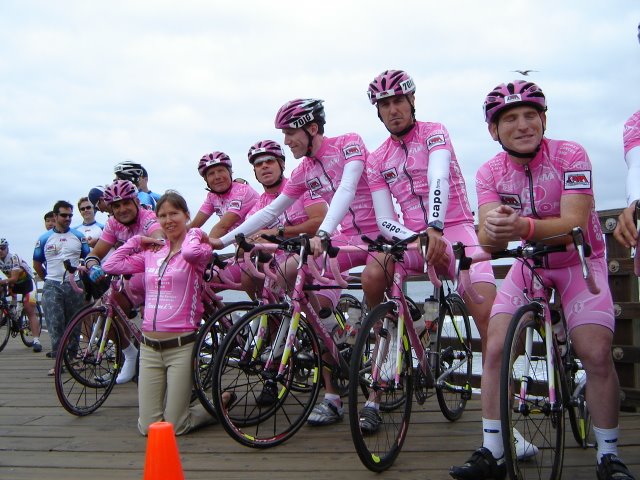
I was shuffling through some pictures and came across this photo of Erika with the 2006 24-hr Beat Cancer Team at the start of the RAAM on Oceanside Pier.

Erika lost her 2.5 year battle with cancer last Wednesday, September 7th.

I have not had the opportunity to speak with the team, but I've been very sad since I heard news of her passing.This picture reminds me of everything we did in her support, but wish we could have done more to help directly. But what?

What I do know is that her fight touched many lives and brought a lot of us closer together. I will personally remember her embracing energy and smile. I miss her and will keep her family in my prayers.
 Posted by Picasa